


How class signifiers shape our perceptions of authority (a letter to The Guardian)

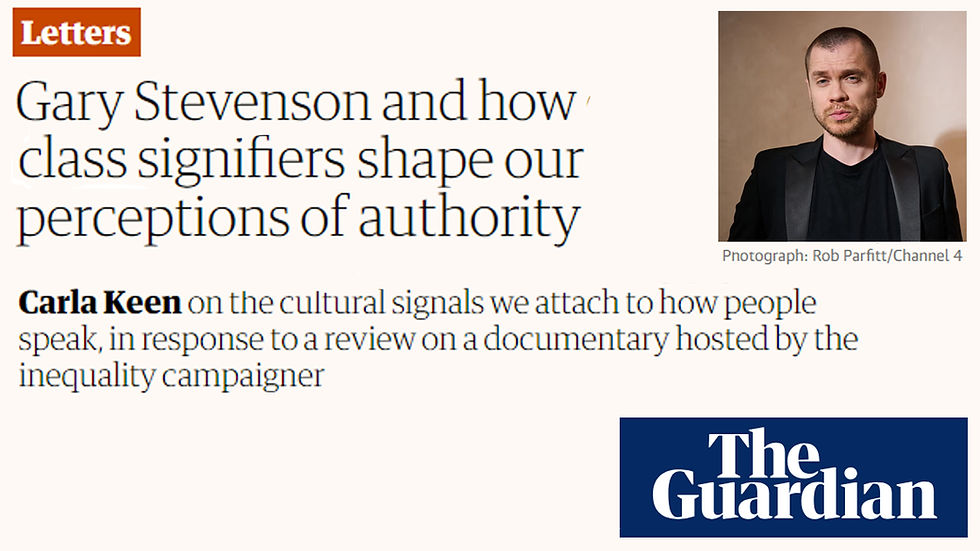
I watched How to Get Filthy Rich by Gary Stevenson. Then I woke up the next morning and read a review of it. And it frustrated the heck out of me. Not because I thought the programme was beyond criticism, but because the review tapped into something I think about a lot: how we perceive authority, expertise and credibility, and how much those perceptions are shaped by class and the way people speak.
In the past, I've often code-switched my accent depending on where I am. I've adapted how I speak, sometimes consciously, but often without even noticing. These days, I take a more deliberate approach: I try not to sand down my Milton Keynes (Milk 'n' Beans) accent to sound more credible. Because why should I?
The funny thing is that refusing to code-switch can itself be read as a kind of aggression. Directness, confidence and regional accents are often interpreted differently depending on who is speaking and who is listening.
I've experienced many forms of mistaken identity along the way. While studying English at university, I was very often assumed to be privately educated. More recently, in a workshop in South London, I found myself having to explain what I meant when I passionately described an immersive theatre experience as 'mennal' ('mental'), because a non-native English speaker didn't recognise the pronunciation. Ironically, I needed to speak less regionally than the accent of the region to be understood because it wasn't the English that was expected.
One of my favourites was when a chugger looked momentarily baffled that the person in leopard-print tights and cut-off shorts had politely replied, 'Thank you, but no, not today' (Like many, I go very posh when being polite.) Apparently, I hadn't dressed appropriately for my accent.
Anyway, here is the letter:
Lucy Mangan’s description of Gary Stevenson as having an “adolescent bullishness” raises a wider question about how class shapes perceptions of authority (How to Get Filthy Rich With Gary Stevenson review – how did this end up such an embarrassment?, 8 July). I am an artist from a working-class background working in theatre, and I am very aware how often authority is often judged through presentation. Our media landscape still has a narrow idea of what expertise looks and sounds like. Research by the Sutton Trust has shown that around half of newspaper columnists and over a third of BBC executives were privately educated, despite private schools educating only a small minority of the population.
Stevenson is now wealthy, highly educated and professionally successful, but class is not only about income or occupation. It is also about the cultural signals that we attach to voice, manner and presentation.
Mangan writes that Stevenson’s manner raises “a sort of fight-or-flight response in the viewer instead of encouraging engagement”. I find myself questioning who “the viewer” is in this statement. Audiences bring their own experiences, expectations and cultural reference points to what they watch. What one person experiences as aggression, another may experience as frustration or passion. Watching the documentary, I saw someone attempting to understand people whose views differed from his own. He allowed interviewees space to explain themselves, even when he disagreed.
I wonder whether some of the reaction to Stevenson is shaped by his direct communication style, working-class background and non-received pronunciation accent. These qualities are often interpreted differently from the same confidence expressed through more traditionally middle-class modes of speech.
Whether or not people agree with his economic arguments, making complex ideas accessible to people who are often excluded from these conversations is valuable.
Carla Keen
Cambridge


Comments